
Searching Chaffee County Criminal Dockets
Start with the free Chaffee-filtered Colorado Judicial Branch Docket Search, the quickest official route to a scheduled criminal event. Pick Chaffee County first. Then choose District Court with CR for a felony, or County Court with M for a misdemeanor. The interface demands at least one filter beyond the date range. An exact case number works best. Without one, a first and last name narrows things down. The class, year, court, and hearing type still have to line up.
A docket search should not stop at the calendar. That matters when the goal is a case history or final outcome. The official Record/Document Request Form sells pieces of the file separately. It offers each piece as a distinct product. Choose the Register of Action, the Complaint/Information, the Disposition/Sentence Order, the Protection Order, or the Ticket.
Other filters narrow the hunt further. Pick from the Eleventh Judicial District, the Chaffee courthouse, court type, division, party, business, attorney name, or attorney bar number. Dates run from today through six months, plus a specific-date option. Results show twenty at a time and can be printed or exported. Remember what the exported row holds. It carries only a setting. There is no charge text, no count-by-count result, no signed order, and no filing image.
- Identify whether the matter is a CR felony or an M misdemeanor.
- Search the Chaffee County calendar by exact year, class, and sequence when known.
- Compare the date, hearing type, location, appearance mode, and courtroom.
- Request the ROA for the full event history, then name any filing or order needed.
- Ask the clerk for certification only when an authenticated copy is required.
Chaffee County Criminal Docket Codes
Chaffee Combined Court runs two criminal tracks under one roof. The letters in a case number tell them apart. A number like 2026-CR-00123 marks a District Court criminal case. An M class marks a County Court misdemeanor. T marks a county traffic matter rather than a general criminal case. Juvenile delinquency classes do not work as ordinary public criminal dockets. Access may be restricted.
| Class | Court | Typical Chaffee docket |
|---|---|---|
| CR | District Court | Felony proceedings |
| M | County Court | Misdemeanor proceedings |
| T | County Court | State or county traffic cases |
The issuing paper and its exact class control everything. A city-code case belongs to the municipal court that received it. The event may still have happened in Chaffee County.
Transfers and appeals can spawn a second number too. When an ROA points back to an originating matter, run both numbers and compare the court location. District Court decisions generally move up to the Colorado Court of Appeals. County Court appeals ordinarily move to District Court. That later case never erases the earlier docket. Read each clerk record within its own court context.
Inside a Chaffee County Criminal Docket
The public Chaffee County criminal calendar shows only the setting slice of a record. Its fields confirm when and where an event is set. That is all they do. Charge history, plea, bond outcome, sentence, financial balance, and document images stay out of view. Those details may appear in a public ROA or a separately requested order. Access limits still apply.
| Case number | Four-digit year, class letters, and sequence, such as 2026-CR-00123. |
|---|---|
| Setting | Date, time, duration, and hearing type. |
| Place | Chaffee location, courtroom, and in-person, virtual, or blank appearance mode. |
| ROA | Chronological filings, minute orders, charges, settings, and recorded outcomes. |
| Case documents | Complaint or information, protection order, disposition, sentence order, and other available filings. |
Confirm what the judge did with the newest signed order. A calendar label only gives notice of an event, not proof of its outcome.
Read Chaffee County Criminal Dockets
Labels seen on Chaffee County criminal dockets include advisement, arraignment, return filing of charges, appearance on bond, status conference, motions hearing, plea/sentencing hearing, show cause, and review with appearance. Each one names the purpose of a scheduled event. Nothing more. A plea/sentencing entry does not establish that a plea occurred or that the court imposed a sentence.
- Advisement
- A hearing about allegations, rights, and next steps.
- Arraignment
- A stage when charges and plea-related issues are addressed.
- Status conference
- A progress-management setting, not usually a trial.
- Appearance on bond
- A setting tied to release status, not the bond outcome itself.
- Disposition
- The recorded result of a charge or case.
When the outcome is what matters, request the Disposition/Sentence Order. That document answers a question the hearing list cannot.
How a Criminal Case Moves
A Chaffee County criminal docket grows entry by entry. The clerk records each filing, setting, minute order, and result as the case moves. The sequence is never identical across cases. A reset can add entries without ending the matter. Even so, the event history tends to follow a recognizable path.
Docket flow: Filing › Advisement or Arraignment › Pretrial Settings › Plea or Trial › Disposition › Sentencing
Read by entry date and event date. A later minute order or notice can replace an older setting. If the public calendar still looks unclear, the fuller Chaffee County case lookup process explains how to copy the exact number before requesting the ROA.
Chaffee County Criminal ROA Comparison
Three papers do different jobs in a Chaffee County criminal case. The Register of Action is the chronology, an index of entries. The Complaint or Information actually states the filed charge. A Disposition or Sentence Order records the outcome. All three may sit in the same file, yet none stands in for the others.
Unsure which paper you need? Start with the ROA. Spot the entry title and date, then ask for that exact item. The clerk charges less for a narrow request than for a whole file. Copying and review costs shrink. Spoken proceedings are different; a transcript needs its own process, not an ordinary copy order.
Fees come from the official request form. Plain copies run $0.25 per page. A name search costs $5, and certified or exemplified copies cost $20 per document. Off-site retrieval is billed at actual cost. Research or redaction past the first hour is listed at $30 per hour. The rate runs in fifteen-minute increments. Treat these as estimates and get a quote before production. The form promises a three-business-day response unless something unusual delays it. The Eleventh Judicial District payment and collections page covers one more piece of the Combined Court workflow: how money moves through a case.
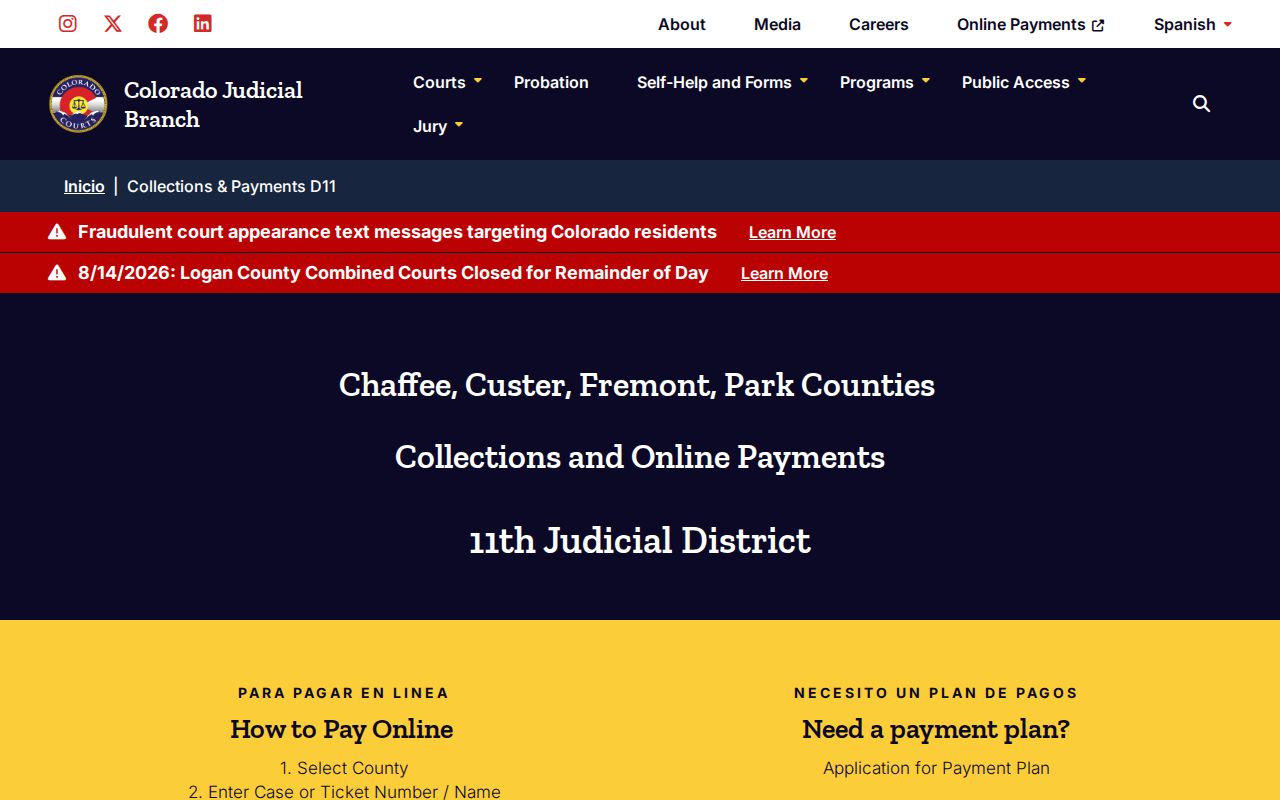
Payment screens and case histories are related clerk functions. But the payment record never replaces the ROA or the disposition order in a Chaffee County criminal docket.
Courts That Hold Criminal Dockets
Two state courts split the Chaffee County criminal docket. The Chaffee County District Court takes CR felony filings under the Eleventh Judicial District. Chaffee County Court handles M misdemeanors and T traffic matters. One office holds both files: the Clerk of Court at Chaffee Combined Court.
Municipal courts sit outside that system. Salida, Buena Vista, and Poncha Springs each keep their own ordinance and municipal-traffic cases. Don't confuse the elected Chaffee County Clerk and Recorder with the court clerk, either. That office runs recording, elections, vehicles, and licensing, not criminal dockets. The names sound alike. Both sit near Crestone Avenue, so the mix-up is easy to make.
Chaffee County Virtual Criminal Dockets
A calendar entry may say IN PERSON, say VIRTUAL, or say nothing at all. A blank appearance field is not permission to appear online. Call the Combined Court at 719-539-2561 before assuming anything. Do that especially after a reset. Or call close to a hearing date.
Parties and lawyers get a WebEx link to join. The public watches through the separate Judicial Branch livestream. It allows no participation. Recording, photographing, capturing, or reproducing the stream is barred without prior written authorization. Treat the stream as a window, not a docket archive.
Note: A printed or exported calendar is only a convenience copy. The current court notice and clerk confirmation control the actual setting.
Chaffee County Criminal Docket Fallbacks
A docket search that returns nothing is not the end. Widen the date range first. Recheck spelling, class, county, and court type. An empty result can simply mean no public setting falls in that window. It never proves a case doesn't exist. The next move is contacting the Chaffee Combined Court clerk at 719-539-2561 or ChaffeeCountyClerk@judicial.state.co.us.
The counter sits at 142 Crestone Avenue, P.O. Box 279, Salida, Colorado 81201. Building hours and clerk-counter hours differ, so check both. From March 1, 2026, the published counter schedule runs 7:30 a.m. to noon and 12:30 to 4:30 p.m. on weekdays, excluding state holidays. For an old or off-site file, call first about access limits, identification, retrieval cost, and certification.
The location page also lists fax 719-530-7017. A separate local page posts a different fax for case questions. Confirm the destination before sending anything private or time-sensitive. The local page says nothing certain about a public terminal either. Ask the clerk directly whether on-site review exists for your criminal class. Don't assume a lobby computer.
Sealed Dockets and Public Access
Colorado policy and statute govern access to Chaffee County criminal court records. Some records are open remotely. Others can be viewed only at the court, and some are excluded or sealed entirely. Suppressed cases, juvenile matters, and files holding protected information can be tightly held. Anyone viewing them may need government-issued photo identification. Added authority can be required too.
The CJD 05-01 public-access directive sets the main rules for court case records. Its page reflects amendments through 2025.
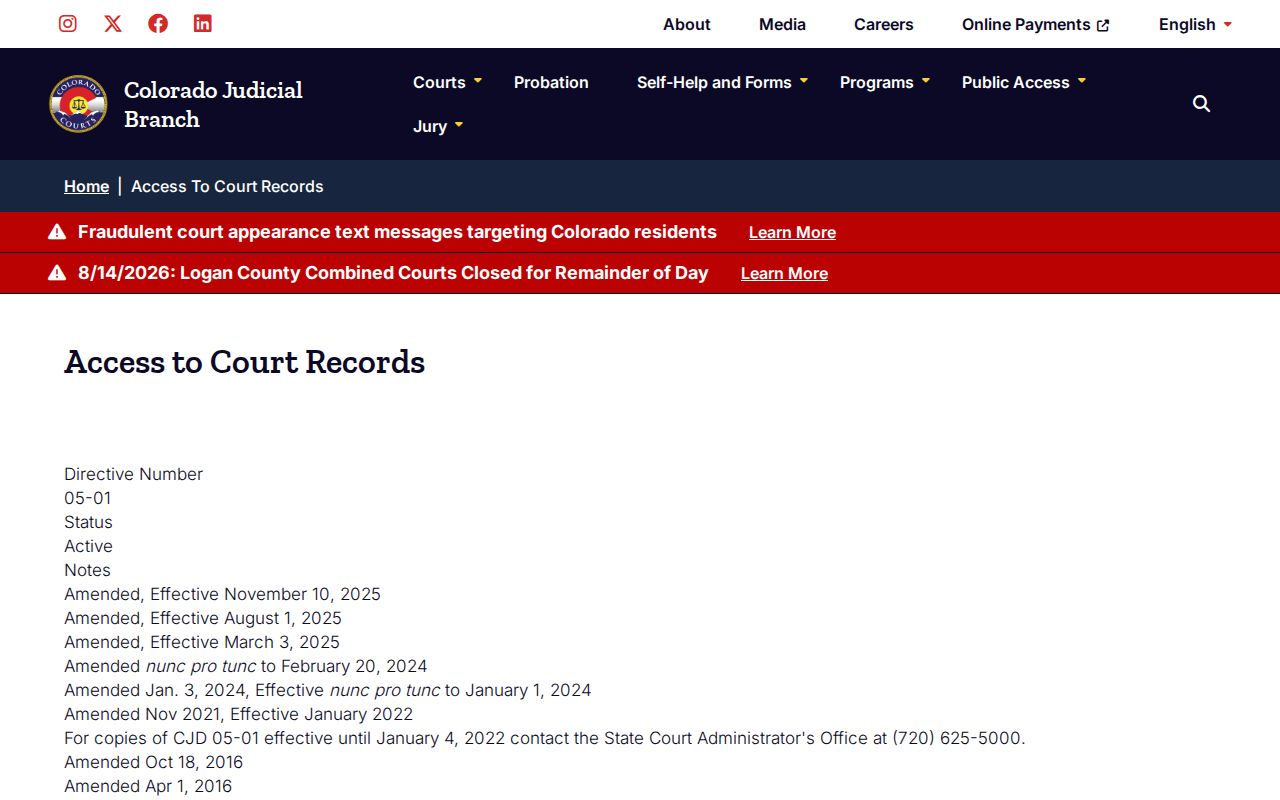
The directive sorts records into remote, facility-only, and excluded tiers. So a blank Chaffee County docket search result is never proof that no criminal case exists.
Key access rules:
CJD 05-01 governs public access, exclusions, fees, and correction of Colorado court case records.
Colorado Legislative Council sealing guidance explains the current difference between sealing and expungement.
C.R.S. sections 24-72-704 through 24-72-710 contain key parts of the criminal-record sealing framework.